ARSENAL 001// SURFACE SELECTION: The Foundation of Cutting Mat
[PLAMOFORGE 3D LOG. Entry No. TOOL-GEAR-001-Cutting Mat]
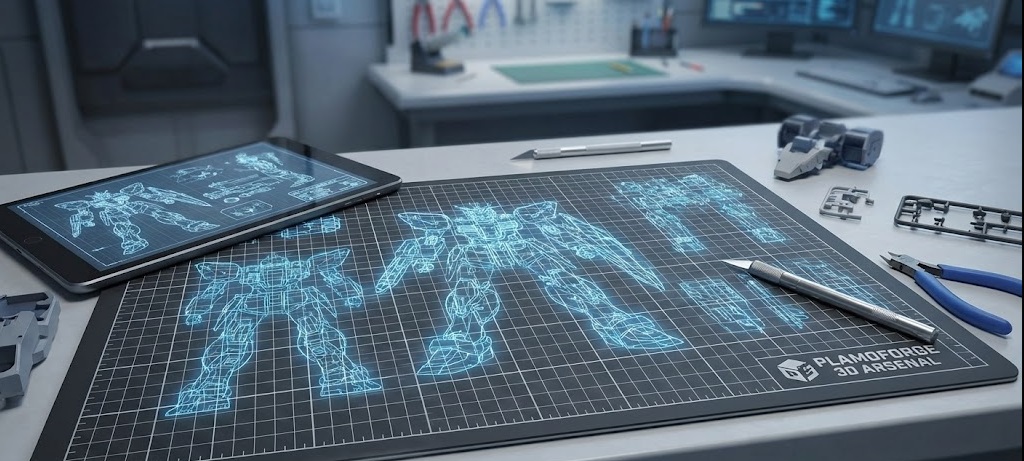
Within Arsenal 001, the positioning of every screw and the execution of every precision cut begins with a stable substrate. The Cutting Mat is not merely a barrier to protect your workbench; it is the “Core Interaction Interface” of precision engineering. Selecting an inferior substrate leads to premature tool degradation, measurement deviations, and can even compromise the surface integrity of your components.
This protocol is designed to guide operators in selecting the optimal Operational Surface for high-intensity modeling tasks.
DATA FILE 01: Core Material — The Self-Healing Substrate
Not all surfaces qualify to support high-precision operations. Under PLAMOFORGE 3D standards, Self-Healing PVC is the only recommended material.
- Mechanism of Action: This material is composed of multiple layers of composite materials. When the blade tip cuts into the mat, the surface layer separates temporarily; however, once the blade is removed, the molecular tension of the structure “closes” the incision.
- Tactical Advantages:
- Extended Tool Life: Reduces frictional resistance against metal blades, maintaining scalpel-grade sharpness for longer durations.
- Prevention of Residual Scratches: Prevents old cut marks from guiding the blade, thereby avoiding “blade drifting” and accidental damage when processing large armor plates.
DATA FILE 02: Visual Intelligence & Chromatics
Color selection should not be based solely on aesthetics, but on Visual Intelligence (visual contrast).
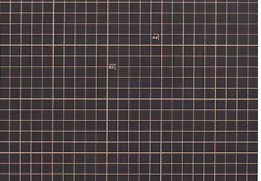
- Tactical Grey / Neutral Black: * Recommended Use: Long-duration operations, photographic documentation.
- Rationale: Reduces optic fatigue and provides clear contrast with most model parts (Grey, White, Dark Blue). Within the PLAMOFORGE 3D environment, neutral backgrounds provide a more professional engineering atmosphere.
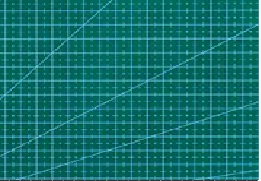
- Operational Green: * Recommended Use: General assembly.
- Rationale: The industrial standard color with high contrast, though it may cause visual afterimages under prolonged high-intensity lighting.
DATA FILE 03: Scale & Grid Specifications
Select the corresponding operational range based on the machine scale (MG, PG, or 3D Printed Suites):
| Classification | Recommended Dimensions | Tactical Application |
| A4 (Compact) | $300 \times 220$ mm | Precision trimming, gate removal, and portable operations. |
| A3 (Standard) | $450 \times 300$ mm | Mainstream Choice. Optimized for part sorting and assembly of MG-scale units |
| A2 (Extended) | $600 \times 450$ mm | Large PG units, full-armor painting layouts, and multi-tasking. |
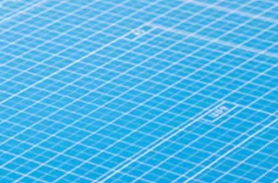
- Grid Precision: Must feature Metric increments and integrated angle guides ($30^\circ, 45^\circ, 60^\circ$) for verifying the perpendicularity of 3D prints or as diagonal references for scribing.
MAINTENANCE LOG: Operational Surface Integrity Protocols
To ensure the continued operational efficiency of Arsenal 001, the following maintenance protocols must be observed:
- Anti-Heat Defense: As a PVC-based material, cutting mats must never encounter heat guns or soldering irons. High temperatures cause permanent warping, destroying the surface flatness.
- Chemical Shielding: Potent thinners or plastic cements will dissolve the self-healing layer. Immediate cleaning is required if spills occur.
- Storage Integrity: Store flat or hang vertically when not in use for extended periods. Never store rolled or bent, as this induces permanent deformation and compromises measurement accuracy.
PLAMOFORGE 3D FINAL DISPOSITION
A superior cutting mat is the most honest dialogue tool between the Artificer and the machine. For operators currently processing MG units or high-performance 3D prints, we recommend:
- Standard Deployment: One A3-sized, Tactical Grey, Triple-Layer Composite Self-Healing Mat.
- Projected Outcome: A 30% increase in part processing precision, significantly reduced blade replacement frequency, and a consistent professional aesthetic for your Arsenal.
[END ARSENAL 001]